
Materials Science and Engineering Assistant Professor Yuting Luo has been awarded a Faculty Early Career Development (CAREER) grant from the National Science Foundation, one of the agency’s most prestigious honors for early-career faculty. The program recognizes faculty who are not only exceptional researchers but also academic role models.
The five-year award, totaling nearly $700,000, will support her project, “Uncovering Molecular Design Principles Linking Additive Chemistry to Zn Anode Structure and Interfacial Electrochemistry,” a study about how chemical additives influence zinc battery performance. Rechargeable zinc batteries are safe, low-cost, made from abundant materials, and show a lot of promise to meet the increasing energy storage needs of the world’s strained electric grids.
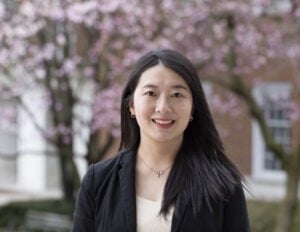
Yuting Luo
The batteries essentially work by moving zinc ions back and forth to store and release energy. They consist of a zinc metal electrode, a cathode host for storing the ions, and an electrolyte liquid.
Luo’s team is studying how subtle changes in the electrolyte can control how the zinc metal grows under an electric field. By tuning this chemical reaction, they can engineer the zinc to significantly improve overall battery lifespan and stability.
“Ultimately, the goal of the project is to establish clear design principles for building safer, more cost-effective, more durable and reliable energy storage systems,” says Luo. “My students and I have put a lot of effort into building this project, so it is very rewarding to see our work recognized and supported.”
Luo, who is a core faculty member in the Johns Hopkins Ralph O’Connor Sustainable Energy Institute, says the NSF award gives her team the opportunity to push their research further and expand its impact on the future of viable and stable energy storage.
“This award opens up opportunities to pursue more ambitious and high-impact research directions,” Luo says. “Just as importantly, it allows us to invest in K–12 outreach, undergraduates and PhD students, and educate the next generation of scientists and engineers to tackle critical energy challenges.”
This story was written by Jack Darrell and originally appeared on the Department of Materials Science and Engineering website.