
Johns Hopkins is part of the new multi-institution Learning Accelerated Domain Sciences (LEADS) Institute, a Department of Energy-funded collaborative initiative focused on reshaping how artificial intelligence supports scientific discovery. Supported through the Scientific Discovery through Advanced Computing (SciDAC) program, the effort seeks to build new AI methods and software tools aimed at solving some of the nation’s most pressing scientific and engineering challenges, including those related to sustainable energy, infrastructure, and materials science.
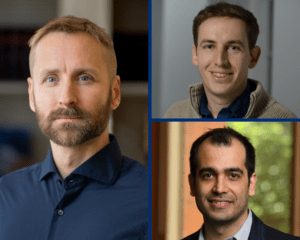
Ján Drgoňa (L); Enrique Mallada (Top-R); Mahyar Fazlyab (Bottom-R)
The Pacific Northwest National Laboratory is leading the effort, which brings together 14 partners, including nine universities and five national laboratories, and will feature scientists across multiple disciplines, ranging from energy systems to materials and computational chemistry. The five-year program includes funding support for three Hopkins principal investigators.
“This isn’t about solving one isolated problem. We’re creating new algorithms and software tools that can address a wide host of challenges,” says Ján Drgoňa, associate professor of civil and systems engineering and a core researcher in the Ralph O’Connor Sustainable Institute (R0SEI). “This work builds upon Hopkins’ leadership at the touchpoint of AI and sustainable energy.”
Along with Drgoňa, the Department of Electrical and Computer Engineering’s Enrique Mallada, an associate professor and associate researcher with ROSEI, and Mahyar Fazlyab, an assistant professor, will lead the Control of Physical Systems efforts, which explores how data-driven AI models and physics-based models can be combined to optimize complex systems.
“Our work will be tackling some of the most challenging problems in critical infrastructure systems with high societal and environmental impacts. One of such problems is high fidelity modeling and optimization of heating, ventilation, and air conditioning in large buildings and data centers,” Drgoňa said. “Another application is large-scale power system optimization, dealing with problems like unit commitment or economic dispatch, which are critical for integrating renewable energy.”
To achieve these goals, Drgoňa will develop novel mathematical and algorithmic frameworks in the field of scientific machine learning by systematically combining physics with AI models to tackle interdisciplinary challenges in a broad set of science and engineering problems. He also will lead open-source software development for broader adoption within the scientific community.
Mallada’s focus is on the information limits of data-driven methods. Currently, building AI models often comes down to trial and error: Defining an architecture, scaling it up, and hoping it works, rather than first considering if AI can be used to solve the problem.
“We’re working to establish theoretical lower bounds so that researchers know up front whether a problem is solvable with the data and architecture available,” Mallada says. “That’s especially important in the physical world, where data is expensive or even impossible to collect sometimes.”
Fazlyab will seek to verify that the AI foundational models satisfy key properties such as stability, safety, and physical consistency. Traditional verification methods require exhaustively checking every single possible solution to verify the desired property, but this method does not work with such large models.
“We need new approaches that combine worst-case verification with statistical methods to make this happen,” Fazlyab says.