
The Ralph O’Connor Sustainable Energy Institute (ROSEI) can announce Peter Mastracco, Liang Wu and Junyan Zhang as the selections for the 2026-27 ROSEI Postdoctoral Scholars Program.
This is the second year that ROSEI has offered the program. The program supports three postdoctoral stipends for the upcoming academic year. The aim of the program is to:
- Broaden or deepen ROSEI’s impact in energy research
- Provide a touchpoint with scholars who will be impactful academics
- Connect and strengthen ROSEI objectives/pillars/identified needs
“This year’s cohort reflects the breadth of innovation happening across sustainable energy research at Johns Hopkins University,” said Susanna Thon, associate director of ROSEI. “All three are each pursuing ambitious work with the potential for meaningful real-world impact. ROSEI is proud to support researchers whose work has the potential to shape the future of the field.”

Peter Mastracco (L); Paulette Clancy (Top-R); Howard Katz (Bottom-R)
Mastracco’s work focuses on the development of new machine learning algorithms to help accelerate the design of complex materials. He was nominated for the program by ROSEI associate faculty members Paulette Clancy, the Edward J. Schaefer Professor in Engineering, and Howard Katz, a professor of materials science and engineering.
Clancy referred to Mastracco as a “creative AI algorithm developer whose expertise and creativity has the potential to transform materials (and process) discovery and optimization” in her nomination letter. She also praised Mastracco for his critical thinking ability and his ability to “draw experimentalists and computational experts to himself. He will be a great poster child for ROSEI’s program.”
“I am honored to have been selected as a ROSEI Postdoctoral Scholar,” said Mastracco, who is in the Department of Chemical and Biomolecular Engineering. “I began my research career studying sustainable materials, and that experience was what first made me fall in love with scientific research. Having the opportunity to continue pursuing work that contributes to sustainable energy and materials design is incredibly meaningful to me, and I am excited to engage more deeply with the ROSEI community through this fellowship.”

Liang Wu (L); Ján Drgoňa (R)
Wu’s research focuses on improving energy efficiency and operational flexibility of data centers. He was nominated for the program by Ján Drgoňa, an associate professor of civil and systems engineering.
In his nomination letter, Drgoňa referred to Wu as a “truly exceptional scholar in all aspects, including technical, intellectual and professional.” He also expressed confidence that Wu “will become a leader in the field of numerical optimization and control of complex systems. ROSEI’s fellowship will help Liang in his career progression towards this bright future.”
“I am deeply honored to be selected for the ROSEI postdoctoral fellowship program,” said Wu, who is in the Department of Civil and Systems Engineering. “I look forward to collaborating across disciplines to advance impactful solutions for sustainable energy systems. Building on my work in large-scale modeling, model predictive control, numerical optimization, learning-based system identification, and learning-to-optimize, I aim to develop scalable and high-performance tools for next-generation energy systems, including AI data centers.”
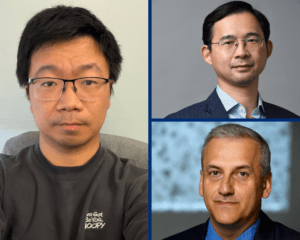
Junyan Zhang (L); Chao Wang (Top-R); Michael Tsapatsis (Bottom-R)
Zhang’s work aims to produce renewable energy and chemicals from biomass-derived feedstocks, such as alcohols and sugars. He was nominated for the program by Chao Wang, a ROSEI core faculty member and a professor of chemical and biomolecular engineering, and Michael Tsapatsis, a ROSEI associate faculty member and the Bloomberg Distinguished Professor of Nanomaterials.
“Junyan has an exceptional record on developing advanced catalysts for energy-related applications, and we are very excited to work with him on new reactive separations for efficient manufacturing,” said Wang and Tsapatsis in a statement.
“It is a great pleasure to be a ROSEI Postdoctoral Scholar, and I sincerely appreciate the institute’s support for the next stage of my work,” said Zhang, who is a member of the Institute for NanoBioTechnology. “The successful synthesis of high-performance catalysts is just the beginning of a long journey in catalysis research. I am also very interested in deciphering the structures of active sites, reaction mechanisms, and kinetics. This will not only provide deeper insights into the fundamentals of chemical engineering but also offer a roadmap for developing better catalysts.”